




The Story Everyone Is Watching, and the Story Almost Everyone Is Missing
Artificial intelligence has become the defining technology story of this decade. Hardly a day passes without another announcement of record-breaking investment in AI infrastructure, a new generation of accelerators, or another hyperscale data center under construction. NVIDIA’s GPUs have become synonymous with the AI revolution, while the capital expenditures of companies such as Amazon, Google, Microsoft, Meta, and Oracle continue climbing to levels that would have seemed extraordinary only a few years ago. TrendForce estimates that the world’s nine largest cloud service providers will invest approximately $830 billion in capital expenditures during 2026, with the overwhelming majority directed toward AI infrastructure, high-performance computing, and next-generation data centers.
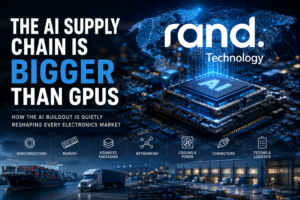
From the outside, the narrative appears straightforward: AI demand is creating an unprecedented race to deploy more compute. That story is accurate, but incomplete. Behind every AI accelerator sits an extraordinarily complex supply chain that extends far beyond GPUs themselves. Every rack deployed into an AI data center depends upon high-bandwidth memory, enterprise storage, advanced packaging, networking silicon, optical interconnects, power management devices, cooling systems, mature-node semiconductors, substrates, connectors, testing, logistics, and hundreds of supporting technologies that rarely appear in headlines but ultimately determine whether infrastructure is delivered on schedule.
The GPU has become the face of artificial intelligence. The supply chain supporting it has become the defining operational challenge. That distinction matters because AI is no longer creating demand for individual components. It is reallocating manufacturing capacity across the global electronics ecosystem.
This subtle but profound shift is beginning to affect organizations that may never purchase a single AI accelerator. Automotive manufacturers, industrial equipment producers, networking companies, medical device developers, aerospace contractors, and consumer electronics companies increasingly depend on the same manufacturing resources being redirected toward AI infrastructure. They are not competing with hyperscalers for finished products. They are competing with them for the industrial capacity required to build those products.
For procurement leaders, this changes the conversation entirely. For decades, supply chains generally operated within familiar cyclical patterns. Demand increased. Lead times expanded. Manufacturers invested in additional capacity. Eventually, markets stabilized. While shortages certainly occurred, most procurement organizations could reasonably assume that supply would gradually rebalance as new capacity entered production. Artificial intelligence has disrupted that assumption.
The AI supercycle is not simply another semiconductor cycle layered onto existing demand. It represents a structural transformation comparable to the emergence of cloud computing or the commercialization of the internet itself. More importantly, it is occurring at a scale that increasingly influences investment decisions throughout the semiconductor industry rather than within isolated product categories.
As James Hill, President and COO of Rand Technology, observes:
“The AI buildout hasn’t simply increased demand. It has changed the operating assumptions behind procurement. Companies that continue relying on yesterday’s supply chain model are finding themselves reacting to disruption instead of anticipating it.”
That observation captures perhaps the most significant change occurring across global technology supply chains. The question is no longer whether AI will influence procurement. The question is how deeply those effects extend, and whether organizations recognize them before they become operational risks.
Artificial Intelligence Is Consuming Capacity, Not Just Components
Every major technology revolution creates a product that captures public attention. The personal computer centered on the CPU. The smartphone revolved around the application processor. Cloud computing focused on the server. Artificial intelligence has elevated the GPU into that role. History, however, suggests that the most significant supply chain transformations rarely occur around the headline product alone. They occur throughout the supporting ecosystem that enables it.
That pattern is repeating itself today. A modern AI server bears little resemblance to the enterprise servers that dominated data centers only a decade ago. Today’s AI platforms integrate enormous amounts of high-bandwidth memory, advanced networking fabrics, high-performance storage, liquid cooling, sophisticated power delivery systems, advanced packaging technologies, and increasingly complex rack-level architectures. None of these systems can be optimized independently. Decisions affecting memory architecture influence processor performance. Cooling requirements shape rack density. Networking bandwidth determines cluster efficiency. Power distribution constrains deployment schedules. Manufacturing, engineering, logistics, and facility design increasingly function as a single interconnected system rather than as separate procurement activities.
Kevin Brown, Chief Supply Chain Officer at Dell Technologies, recently described this evolution as a transition from sequential execution toward parallel operating models. Traditional IT infrastructure could often be planned, sourced, integrated, and deployed in stages. AI infrastructure requires compute, networking, cooling, power, and facility engineering to be developed simultaneously, as each subsystem directly influences the performance and reliability of the others. Dell’s broader argument is that AI is shifting technology supply chains from linear, product-centered models toward tightly integrated ecosystems.
That observation extends far beyond hyperscale cloud providers. It signals a fundamental change in the operating model governing the electronics supply chain itself. As AI deployments accelerate, demand no longer flows neatly through individual product categories. Instead, it propagates through an increasingly interconnected manufacturing ecosystem where capacity constraints in one segment rapidly influence adjacent markets.
Electronics Supply Chain Weekly Digest provides compelling evidence that this transition is already underway. Advanced packaging providers continue implementing substantial price increases as AI demand consumes available capacity. Mature-node foundries expect pricing pressure to persist at least through 2027 as manufacturing resources are increasingly directed toward AI-related applications. Infineon recently opened its Smart Power Fab ahead of schedule to support growing demand from AI data centers and electric vehicles, while Vanguard International Semiconductor expects tight 8-inch foundry capacity well into next year as AI infrastructure drives additional demand for mature-node power devices.
Viewed independently, these developments appear unrelated. Viewed together, they reveal a consistent pattern: artificial intelligence is no longer consuming only advanced processors. It is consuming manufacturing capacity itself. Once capacity becomes the constraining resource, every industry that depends on it begins competing within the same ecosystem.
The Hidden Competition for Manufacturing Capacity
The consequences of this shift become much clearer when viewed from the perspective of a procurement organization. Historically, supply chains were largely organized around industry-specific demand. Automotive manufacturers monitored automotive production forecasts. Industrial automation companies followed capital spending in manufacturing. Telecommunications providers tracked carrier infrastructure investments, while consumer electronics companies focused on seasonal buying cycles and product launches. Although semiconductor manufacturing has always served multiple industries simultaneously, procurement teams could generally assume that they were competing most directly with companies producing similar products.
Artificial intelligence has fundamentally altered that competitive landscape. Today, organizations with little connection to AI applications increasingly compete with hyperscale cloud providers for access to the same manufacturing ecosystem. An industrial automation company purchasing power-management integrated circuits may rely on the same mature-node fabrication capacity that now supports AI servers. An automotive OEM developing next-generation software-defined vehicles may depend upon memory technologies whose production priorities are increasingly influenced by demand from generative AI infrastructure. A networking company may discover that advanced packaging capacity originally expected to support its switch silicon has instead been redirected toward AI accelerators.
These organizations are not purchasing identical products. They are competing for identical manufacturing resources.
That distinction represents one of the most significant structural changes occurring within the electronics industry today. Modern semiconductor manufacturing is no longer constrained primarily by finished inventory. Increasingly, it is constrained by specialized production capacity advanced packaging facilities, mature-node wafer fabrication, substrate manufacturing, high-bandwidth memory production, engineering talent, and highly specialized testing capabilities. Those resources require years of investment to expand and cannot be increased quickly in response to sudden changes in demand.
As suppliers evaluate where to deploy that limited capacity, their decisions increasingly favor applications offering the highest long-term growth potential and economic return. Given the extraordinary scale of AI infrastructure investment currently underway, manufacturing resources are naturally being directed toward AI-related technologies.
The Rise of Second-Order Shortages
The semiconductor industry has experienced shortages before, but AI is introducing a different kind of constraint; one that develops gradually and often escapes attention until its consequences are already being felt. During the semiconductor shortages that followed the COVID-19 pandemic, public attention focused primarily on advanced processors and automotive microcontrollers. Those components certainly represented significant bottlenecks, but many production disruptions ultimately resulted from far less visible devices: analog integrated circuits, voltage regulators, passive components, power management devices, and other supporting technologies that represented only a small fraction of a finished product’s cost but were absolutely essential to its completion.
Artificial intelligence is beginning to create a similar pattern. The first-order shortage is obvious. It is GPUs. Every executive, investor, and technology publication understands that advanced AI accelerators remain in extraordinary demand. The second-order shortages, however, are developing much more quietly. They emerge as AI infrastructure consumes increasing amounts of memory, advanced packaging, networking silicon, power devices, cooling technologies, mature-node semiconductors, optical components, and engineering resources required to support those accelerators.
These supporting technologies rarely generate headlines because they are not the centerpiece of AI systems. Yet they increasingly determine whether those systems, and countless other products competing for the same resources, can be manufactured on schedule.
Memory provides perhaps the clearest example. High-bandwidth memory has become one of the defining technologies enabling modern AI accelerators, but the effects extend well beyond HBM itself. As suppliers prioritize higher-value AI products, pressure begins spreading throughout the broader memory ecosystem, influencing DDR5 modules, enterprise solid-state drives, LPDDR devices, and other products serving entirely different markets.
Recent developments suggest those effects are already materializing. According to reports cited in this week’s market digest, Apple has sought regulatory approval to diversify its DRAM sourcing strategy as AI-driven memory costs continue placing pressure on hardware margins. Likewise, expect MacBook pricing to increase as elevated memory and power management costs persist, illustrating how AI infrastructure investment is influencing product categories far removed from hyperscale computing.
The significance of this example extends beyond Apple itself. If one of the world’s largest semiconductor purchasers is adjusting its procurement strategy in response to AI-driven memory dynamics, it is reasonable to expect similar pressures across organizations with significantly less purchasing leverage. The implications are particularly important for industrial manufacturers, networking companies, medical device producers, and automotive OEMs that rely upon many of the same memory technologies while competing in markets with different pricing dynamics and production cycles.
Rose Delgado, Vice President of Global Sales at Rand Technology, sees this transition reflected directly in customer conversations.
“The AI supercycle turned memory into the hardest part of the build. We help customers stay ahead of allocation, not be at its mercy. That takes optionality backed by real quality, visibility, and execution.”
Her observation illustrates an important change in procurement philosophy. Organizations are no longer asking only where components are available today. Increasingly, they want to understand where capacity is moving next, which adjacent technologies are likely to tighten, and how seemingly unrelated market developments could affect future production. That is a fundamentally different conversation from the one the industry was having only a few years ago.
Procurement Is Becoming Capacity Management
These developments suggest that procurement itself is entering a new phase of evolution. For decades, procurement organizations were evaluated primarily through operational metrics: purchase price variance, supplier performance, inventory turns, forecast accuracy, and working capital efficiency. Those measures remain important and will continue to define operational excellence. Yet AI has expanded procurement’s responsibilities beyond transactional purchasing.
Increasingly, procurement leaders are expected to understand industrial capacity itself.
That expectation explains why long-term strategic agreements are becoming increasingly common throughout the semiconductor industry. Rather than relying exclusively on transactional purchasing, organizations are seeking greater certainty around future production capacity. Micron’s long-term memory agreement with General Motors is one example of manufacturers securing strategic access to future supply rather than competing solely through spot-market procurement.
Similar strategies are emerging elsewhere across the technology ecosystem. Companies are investing earlier, collaborating more closely with suppliers, qualifying alternative technologies before shortages emerge, and treating manufacturing relationships as long-term strategic partnerships rather than purely commercial transactions.
This shift closely mirrors the operating model described by Dell Technologies’ Kevin Brown. As AI infrastructure becomes more interconnected, success increasingly depends on coordinating engineering, manufacturing, logistics, power, cooling, networking, and supplier ecosystems simultaneously rather than optimizing each independently. Procurement is no longer purchasing components in isolation. It is helping orchestrate an integrated system.
That evolution fundamentally changes what successful supply chain leadership looks like. Organizations that continue to measure procurement primarily through cost reduction will certainly remain efficient. The organizations that combine cost discipline with visibility, engineering collaboration, market intelligence, and strategic capacity management, however, will increasingly prove resilient as AI continues to reshape the global electronics industry.
The Procurement Operating Model Has Changed
The most significant impact of artificial intelligence may ultimately have very little to do with artificial intelligence itself. Instead, it may be remembered as the moment procurement organizations were forced to rethink how supply chains actually function.
For decades, procurement excellence was defined by optimization. Organizations invested heavily in forecasting, supplier rationalization, lean inventory management, cost reduction initiatives, and increasingly sophisticated enterprise resource planning systems. These disciplines delivered measurable results because they reflected the realities of the market at the time. Most supply chains remained relatively linear. Engineering designed products. Procurement sourced components. Manufacturing built them. Logistics delivered them. Each function optimized its own portion of the process while relying on relatively stable relationships between suppliers, manufacturers, and customers.
That model is beginning to break down. Artificial intelligence is exposing the limitations of treating supply chains as a sequence of independent transactions rather than an interconnected operating system. Decisions made within one segment increasingly influence outcomes across every other segment. Engineering choices affect sourcing flexibility. Manufacturing investments alter procurement strategy. Packaging capacity influences product roadmaps. Logistics constraints shape inventory decisions. Government policy, geopolitical developments, energy infrastructure, and capital investment now influence component availability just as directly as supplier performance once did.
The supply chain has become a network of interdependencies.
That observation aligns closely with Dell Technologies’ description of AI infrastructure as an ecosystem rather than a collection of products. As Kevin Brown argues, AI has shifted technology infrastructure from sequential execution to parallel development, from independently optimized systems to tightly integrated platforms, and from transactional supplier relationships to long-term strategic ecosystems. While Dell describes this transformation through the lens of hyperscale infrastructure, the implications extend far beyond data centers. The same structural changes are increasingly shaping procurement decisions throughout automotive, industrial automation, networking, medical technology, aerospace, and virtually every segment of advanced electronics.
The practical implication is straightforward: procurement is evolving from purchasing to orchestration.
The role of procurement leaders is no longer limited to negotiating price, monitoring lead times, and issuing purchase orders. Increasingly, they are expected to understand how engineering decisions influence sourcing flexibility, how manufacturing investments alter future capacity, how quality systems support alternate sourcing strategies, and how geopolitical events may reshape supplier ecosystems long before disruptions appear within traditional procurement metrics.
That is a fundamentally different responsibility from the one procurement held only a decade ago. It also requires a different definition of resilience. For years, resilience was frequently measured by recovery. Organizations judged themselves by how quickly they responded after a disruption occurred. AI suggests a more demanding standard. Increasingly, resilience is measured by how effectively organizations anticipate disruptions before they occur. Companies that identify emerging constraints while multiple options remain available can often avoid the operational consequences experienced by organizations that wait for shortages to become visible.
Visibility therefore becomes considerably more valuable than information. Every company has access to market headlines. Every company can monitor published lead times. Every company can review supplier scorecards and pricing trends. Competitive advantage comes from connecting those individual signals into a coherent understanding of where the market is moving before consensus develops.
This week’s market activity illustrates precisely why that capability matters. Advanced packaging providers continue to raise prices despite substantial capital investment because AI demand continues to absorb available capacity. Mature-node foundries expect elevated utilization for years rather than quarters. Automotive manufacturers are increasingly securing long-term memory agreements to reduce their exposure to future allocation risk. Consumer electronics companies are reevaluating sourcing strategies as memory economics shift. These developments appear independent when viewed as news headlines. Viewed together, however, they describe an industry reorganizing itself around artificial intelligence.
Organizations capable of recognizing those connections early gain something far more valuable than better market awareness. They gain time:
- Time to qualify alternate components.
- Time to engage engineering teams.
- Time to diversify suppliers.
- Time to reposition inventory.
- Time to collaborate with manufacturing partners.
- Time to make strategic decisions before urgency removes flexibility.
That advantage becomes increasingly important because AI is unlikely to represent a temporary market cycle. Industry investment suggests that artificial intelligence is becoming foundational infrastructure comparable to electricity, telecommunications, or cloud computing. As those investments continue, manufacturing priorities will continue evolving alongside them.
Waiting for markets to “return to normal” may therefore become an increasingly risky strategy.
Normal itself is changing.
Optionality Is Becoming the New Currency of Supply Chain Leadership
As procurement shifts toward orchestration, one concept increasingly separates resilient organizations from reactive ones: optionality.
Optionality is often misunderstood as maintaining multiple suppliers or carrying additional inventory. Those practices can certainly contribute to flexibility, but they represent only a small portion of what optionality actually means. At its core, optionality is organizational adaptability. It is the ability to change course without sacrificing execution.
It means qualifying alternative technologies before shortages occur, rather than after they disrupt production. It means maintaining supplier ecosystems that extend beyond traditional channels while preserving rigorous quality standards. It means combining engineering expertise, market intelligence, testing capabilities, inventory strategy, logistics, and sourcing into a coordinated operating model that responds to change without compromising product integrity or customer commitments.
In other words, optionality is not an emergency plan. It is a business strategy.
That distinction is becoming increasingly important because the electronics industry is moving from an environment primarily characterized by efficiency toward one that requires both efficiency and adaptability. Cost discipline remains essential. Forecast accuracy continues to matter. Strong supplier relationships remain indispensable. Yet those characteristics alone no longer guarantee continuity when manufacturing capacity itself becomes the market’s most constrained resource.
Organizations that build optionality into their operating models are better positioned to adapt as markets evolve. They have already invested in engineering flexibility. They have already developed broader supplier ecosystems. They have already established quality systems capable of validating alternate sources. They have already created the visibility necessary to recognize emerging constraints before they affect production. They do not eliminate uncertainty. They reduce its consequences.
As Rose Delgado observed earlier, customers increasingly want to stay ahead of allocation rather than simply react to it. That subtle change reflects a broader evolution occurring throughout procurement leadership. Organizations are no longer asking only how to buy components more efficiently. They are asking how to preserve strategic flexibility in an environment where capacity, not inventory, increasingly determines competitive advantage.
That is precisely why independent distribution has evolved over the past three decades. Historically, many organizations viewed independent distributors as contingency providers engaged only when authorized channels could not fulfill demand. That perception reflected a very different market. Today’s leading independent distributors operate global engineering organizations, certified quality laboratories, counterfeit-mitigation programs, worldwide logistics networks, inventory-management solutions, and sophisticated market-intelligence capabilities. Their role is no longer simply locating components.
It is helping customers create optionality.
That distinction is important because it fundamentally changes how value is measured. Success is no longer determined solely by whether a difficult component can be sourced today. Increasingly, success is measured by whether customers avoid reaching crisis mode in the first place because they had the visibility, engineering support, sourcing flexibility, and quality infrastructure necessary to adapt earlier.
In many respects, that represents the quiet transformation taking place throughout the supply chain industry. The value of a supply chain partner is becoming less about access. It is becoming more about foresight.
The Supply Chain Is No Longer Self-Correcting
Artificial intelligence will undoubtedly be remembered for the remarkable technologies it enables. New computing architectures will accelerate scientific discovery. Software will become more capable. Manufacturing will become more intelligent. Entire industries will continue adopting AI-driven tools that improve productivity and reshape competitive landscapes.
Yet one of AI’s most enduring legacies may prove to be far less visible. It has fundamentally exposed the limits of traditional procurement thinking.
The assumption that supply chains naturally rebalance over time was always somewhat incomplete. Markets did not stabilize on their own; they stabilized because demand patterns, manufacturing investment, and product lifecycles generally evolved slowly enough for organizations to adapt without fundamentally changing their operating models. Artificial intelligence has accelerated those dynamics beyond the assumptions that shaped traditional procurement strategies.
Manufacturing capacity is now allocated according to long-term strategic priorities rather than short-term transactional demand. Engineering decisions increasingly influence sourcing flexibility. Supplier ecosystems matter more than individual supplier relationships. Visibility has become more valuable than historical reporting. Optionality has become more valuable than optimization alone.
Perhaps most importantly, organizations are discovering that resilience is no longer something achieved after disruption.
It is something designed before disruption occurs.
James Hill summarizes this shift succinctly:
“Supply chains don’t balance themselves. They never really did. Markets simply moved slowly enough that it appeared they did. AI has removed that illusion. The organizations that succeed over the next decade will be the ones that actively manage change instead of waiting for markets to correct themselves.”
That observation captures the central lesson of the AI era. The companies that thrive will not necessarily be those with the largest procurement organizations or the greatest purchasing leverage. They will be the organizations that recognize the supply chain itself has become a strategic capability; one requiring continuous visibility, engineering collaboration, disciplined quality systems, intelligent inventory strategies, and ecosystem partnerships capable of adapting as quickly as the markets they support.
The public conversation will continue to focus on GPUs. It should. They remain among the most important technologies of our time. But procurement leaders would be wise to remember that GPUs are only the visible expression of a much larger transformation. The real story is unfolding across the interconnected ecosystem that powers them; and that ecosystem now reaches into virtually every corner of the global electronics industry.
The AI supply chain is bigger than GPUs.
Understanding that broader picture is no longer an advantage. It is rapidly becoming a requirement for every organization that intends to compete in the next generation of technology.