





For the last two years, nearly every conversation about semiconductor shortages has centered on the same handful of technologies: GPUs, HBM memory, advanced packaging, and AI accelerators. Those concerns are valid. NVIDIA’s continued growth, hyperscaler AI infrastructure expansion, and the race to build larger and more capable AI models have reshaped the global technology landscape.
But beneath the headlines, a quieter, potentially broader supply chain shift is emerging.
The strain that first appeared in advanced compute is now moving downstream into the mature-node analog, power management, and board-level component ecosystem that supports everything from automotive and industrial systems to networking infrastructure and enterprise hardware.
In many ways, this is the next phase of the AI supply chain story.
According to the latest Edgewater Research Semiconductor Supply Chain report, demand remains constructive across the semiconductor ecosystem, but customer behavior is changing rapidly. Automotive Tier 1 suppliers are reportedly increasing inventory targets from roughly 4 weeks to as much as 12 weeks, while supply assurance practices are expanding globally.
At the same time, suppliers including Texas Instruments, NXP, and STMicroelectronics are implementing or preparing additional pricing increases as lead times extend and customers pull inventory forward.
The implications extend far beyond AI servers.
Because the same mature-node analog and power infrastructure supporting AI datacenters also underpins electric vehicles, industrial automation, telecom systems, energy infrastructure, and countless embedded technologies, the market may be entering a new phase of supply competition.
While we may sound like a broken record, this is not simply another cyclical semiconductor recovery. It is a structural collision between accelerating AI infrastructure investment and the foundational analog and power supply chains that support the modern economy.
The AI Supply Chain Story Is Evolving
The first phase of the AI boom was obvious.
Companies raced to secure GPUs, HBM memory, CoWoS packaging capacity, and advanced compute infrastructure. Hyperscalers announced enormous capital expenditure plans. NVIDIA became one of the most valuable companies in the world. TSMC capacity tightened dramatically. Memory suppliers shifted wafer allocation toward HBM production.
The industry largely understood the bottlenecks.
Today, however, the pressure is spreading into less visible areas of the supply chain.
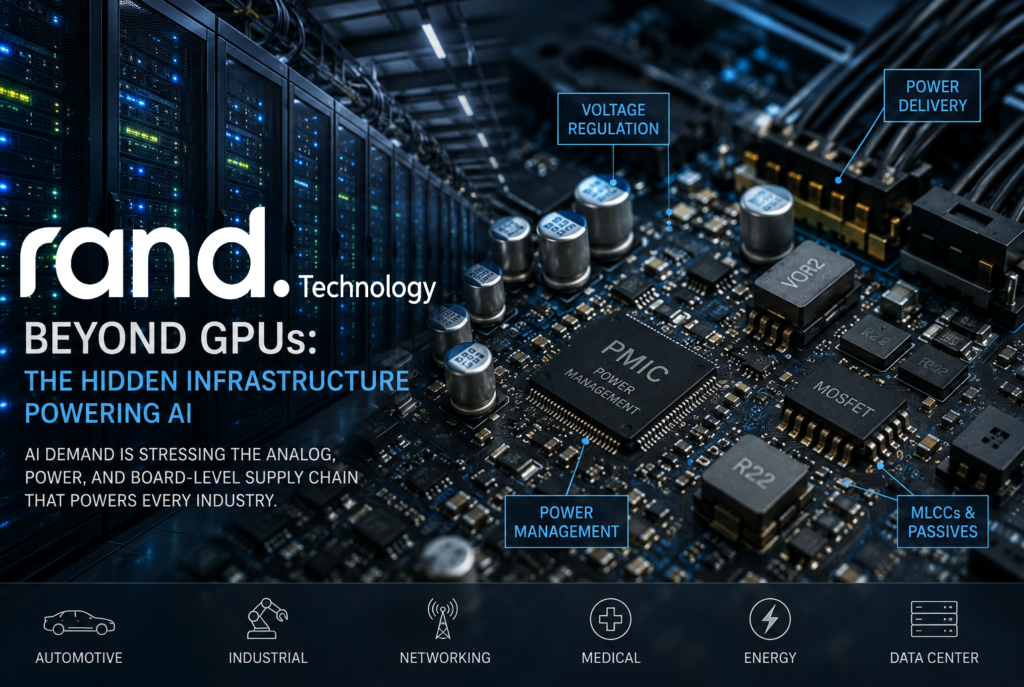
AI infrastructure requires extensive support for power management, voltage regulation, thermal control, networking, PCB substrate technology, capacitors, connectors, PMICs, MOSFETs, and board-level analog content. As AI servers become increasingly power-intensive, the amount of analog and power content required per rack continues to rise significantly.
AI server deployment is now dramatically impacting MLCC consumption, with Nvidia Rubin boards expected to consume roughly 12,000 MLCCs each, compared to approximately 6,500 on previous-generation GB200 systems.
That matters because MLCCs are not isolated AI components. They are foundational components used across automotive systems, industrial electronics, networking equipment, medical devices, aerospace applications, and consumer hardware.
As suppliers redirect capacity toward higher-margin AI demand, traditional sectors may begin competing for increasingly constrained mature-node supply.
Rand Technology CEO Andrea Klein recently summarized the situation directly:
“AI demand continues, but demand is now picking up outside the AI ecosystem. Customers are seen restocking now. Shortages are spreading into board-level components. AI infrastructure is pulling demand into the exact mature-node analog/power supply chain that serves automotive, industrial, and networking customers.”
That warning should not be overlooked.
While GPUs dominate headlines, analog and power semiconductors are the connective tissue of modern electronics.
And those supply chains are becoming increasingly stressed.
The Return of Supply Assurance Behavior
One of the clearest signals emerging from the market is the return of supply assurance behavior.
During the pandemic-era semiconductor shortages, customers extended forecasts, increased safety stock, double-booked inventory, and prioritized supply continuity over price optimization.
For much of 2024 and early 2025, many believed those behaviors had normalized. The latest data suggests otherwise.
Tier 1 suppliers are reportedly rebuilding inventory aggressively, with average inventory targets rising from approximately 4 weeks to 12 weeks. Bookings-to-billings ratios remain elevated, while some suppliers estimate that as much as 15% of current orders may represent double bookings.
At the same time, lead times for high-end analog and power components are extending beyond 35 weeks, with broadline analog products trending toward 20–26 weeks and likely rising further. These behaviors are important because they create self-reinforcing market dynamics.
As customers grow concerned about availability, they increase inventory buffers. As inventory buffers grow, lead times extend further. As lead times extend, additional customers begin securing inventory earlier. Eventually, procurement behavior itself becomes part of the shortage cycle.
Rand Technology Global Director of Sales Kyle Miller sees this shift occurring in real time:
“What we’re seeing now is a transition from tactical buying back toward strategic supply assurance. Customers are realizing that waiting until shortages become visible is already too late. The organizations that are performing best today are the ones securing flexibility early, expanding sourcing strategies, and building stronger relationships across the supply chain before allocation conditions fully materialize.”
That observation reflects a broader reality across the electronics market.
Many companies spent the last several quarters assuming that pricing normalization and improved lead times signaled a return to pre-pandemic supply conditions.
But the AI infrastructure cycle is creating entirely new forms of demand pressure.
And unlike prior semiconductor cycles, this one is increasingly impacting mature-node technologies that cannot be scaled quickly.
Mature-Node Constraints Are Becoming Strategic
One of the most misunderstood aspects of the current market is the importance of mature-node semiconductor manufacturing.
While cutting-edge AI accelerators receive most of the attention, many analog, PMIC, MOSFET, microcontroller, and power management products continue to rely heavily on mature manufacturing nodes, including 8-inch wafer production.
Unfortunately, those supply chains are not scaling rapidly.
Semivision notes that 8-inch foundry supply is expected to decline slightly year-over-year, even as AI server, edge AI, and EV power demand accelerates. That imbalance matters enormously.
Unlike advanced-node AI compute capacity, which continues receiving billions in investment, mature-node capacity expansion has been comparatively limited for years. Many suppliers historically viewed mature-node technologies as lower-growth or lower-margin businesses.
Now those same mature nodes are becoming mission-critical again.
Power management ICs, analog devices, industrial semiconductors, automotive electronics, and energy infrastructure systems all depend heavily on these technologies. At the same time, the transition toward electrification, AI infrastructure, robotics, industrial automation, and energy modernization is simultaneously accelerating demand across multiple industries. The result is structural pressure on a manufacturing base that was never designed for this level of synchronized global demand.
Why Automotive Is Reentering the Picture
Automotive demand is particularly important in this cycle because the sector had previously remained somewhat cautious despite improving semiconductor fundamentals. That caution appears to be fading.
The Boston Consulting Group reports that automotive customers are now actively participating in supply assurance and replenishment activity globally. China’s automotive market remains especially influential. The report highlights substantial growth in demand for onboard chargers and continued NEV expansion.
At the same time, vehicle architectures themselves are becoming dramatically more semiconductor-intensive.
Electric vehicles require significantly greater analog and power content than traditional internal combustion vehicles. Advanced driver assistance systems, battery management systems, onboard charging, thermal management, infotainment, connectivity, and autonomous features all increase semiconductor complexity.
And AI is beginning to directly intersect with automotive infrastructure.
Modern vehicles increasingly rely on AI-enabled sensing, edge processing, connectivity, and software-defined architectures. That convergence places additional pressure on already constrained component ecosystems.
Meanwhile, geopolitical dynamics continue complicating global automotive supply chains.
Volkswagen has begun airfreighting some components due to uncertainty over shipping routes through the Strait of Hormuz.
Even when shortages are not catastrophic, logistics instability, geopolitical risk, and elongated lead times create operational friction that pushes customers toward more defensive inventory strategies.
Power Infrastructure May Become the Hidden AI Bottleneck
Another major theme emerging from the market is the growing importance of power-delivery infrastructure within AI data centers.
Historically, discussions of semiconductors focused primarily on compute performance. Today, power efficiency and power conversion are becoming equally important. Modern AI systems consume extraordinary amounts of electricity. Datacenter operators are now redesigning entire power architectures to support next-generation AI workloads.
Texas Instruments recently indicated that broad 800V adoption in AI data centers may begin ramping in 2027, with the industry still evaluating multiple power-conversion architectures.
Analog Devices also recently acquired voltage regulator module startup Empower to strengthen its AI power delivery position.
These developments matter because AI infrastructure is no longer just a compute challenge. It is increasingly a power management challenge.
Every AI rack requires sophisticated power conversion, voltage regulation, thermal optimization, and board-level engineering. As rack density increases, the complexity of supporting analog infrastructure rises alongside it.
This creates new demand pressure for:
- PMICs
- MOSFETs
- Voltage regulators
- Capacitors
- High-density PCB technologies
- Thermal components
- Power delivery architectures
- Board-level interconnect systems
These are not niche technologies. They are foundational technologies used throughout the global electronics ecosystem.
The Pricing Environment Is Changing Again
Pricing behavior across the analog and power semiconductor market is also shifting rapidly. Texas Instruments is implementing 15–25% price increases across broad product categories, effective July 1, while NXP and STMicro are pursuing additional price increases in June and July
There is also a growing regional pricing divergence between China and Western markets, creating potential arbitrage opportunities and selective inventory accumulation. Historically, pricing increases alone do not necessarily signal a shortage cycle.
But pricing increases combined with:
- buffer inventory requests,
- lead-time extensions,
- elevated bookings,
- double-booking concerns,
- supply assurance behavior,
- and accelerating AI demand
collectively paint a more meaningful picture.
The market is tightening.
And importantly, the tightening is no longer isolated to advanced compute.
Why Traditional Procurement Strategies Are Struggling
Many procurement organizations were built around assumptions that no longer fully apply to today’s market environment.
Traditional procurement models often emphasize:
- lean inventories,
- short-term price optimization,
- quarterly purchasing cycles,
- and highly centralized sourcing decisions.
Those models work effectively in stable markets. They become far less effective during structural technology transitions. AI infrastructure growth is introducing new forms of demand unpredictability across multiple tiers of the supply chain simultaneously. In prior cycles, shortages were often isolated to specific technologies.
Today, shortages can emerge from second-order effects:
- substrate availability,
- packaging capacity,
- board-level passives,
- mature-node foundries,
- power infrastructure,
- or regional geopolitical disruptions.
The challenge is no longer simply identifying constrained parts. The challenge is understanding how interconnected supply ecosystems behave under stress.
Organizations relying exclusively on transactional sourcing strategies may find themselves increasingly exposed to:
- allocation risk,
- sudden lead-time expansion,
- counterfeit exposure,
- gray-market volatility,
- and operational delays.
This is one reason companies are beginning to prioritize supply chain resilience alongside cost efficiency.
Quality Risk Increases During Tight Markets
One of the less-discussed consequences of tightening markets is the corresponding increase in counterfeit activity and quality risks.
As supply becomes constrained, unauthorized channels often become more active. Components may move through multiple intermediaries, traceability may weaken, and quality assurance becomes more difficult.
This is particularly important in analog and power categories because these components are frequently deployed in mission-critical environments:
- automotive systems,
- industrial controls,
- aerospace platforms,
- medical devices,
- networking infrastructure,
- and energy systems.
A single quality failure can create substantial operational consequences.
That reality reinforces the importance of rigorous inspection, testing, traceability, and supplier validation processes during periods of supply instability.
At Rand Technology, quality assurance and component authentication remain central to supply continuity strategies, particularly as procurement organizations increasingly balance urgency against risk.
The AI Economy Is Expanding Beyond Hyperscalers
Another important misconception is that AI demand only impacts hyperscalers.
In reality, AI infrastructure expansion is now influencing nearly every segment of the electronics ecosystem. The New York Times notes that Google, Amazon, Microsoft, Meta, and Oracle are expected to account for more than 60% of global demand for Nvidia’s rack-scale AI servers in 2026.
But the secondary effects extend much further.
Industrial automation companies are investing in AI-enabled robotics. Automotive OEMs are integrating AI-assisted systems into vehicles. Energy infrastructure is modernizing to support datacenter expansion. Networking companies are upgrading architectures for AI traffic growth. Edge computing deployments continue increasing globally. And every one of those trends consumes analog, power, board-level, and mature-node semiconductor content. The cumulative effect is broadening demand across the entire electronics value chain.
This Is Why 2027 Matters
Perhaps the most important takeaway from the current market is that many suppliers now see visibility extending well into 2027. That is highly unusual.
Semiconductor markets are traditionally cyclical and relatively difficult to forecast beyond several quarters. Yet many suppliers are now discussing:
- 2027 CoWoS allocations,
- multi-year packaging expansion,
- long-term AI infrastructure deployment,
- power architecture transitions,
- and sustained datacenter buildouts.
Digitimes notes that some suppliers already see customer orders extending into 1H27. That longer-term visibility dramatically changes procurement behavior. If customers believe shortages may persist beyond normal cyclical timelines, they begin making structural adjustments:
- longer planning horizons,
- strategic inventory positioning,
- supplier diversification,
- AVL flexibility,
- and earlier sourcing engagement.
Those changes can become self-sustaining.
What Companies Should Be Doing Now
Organizations do not need to panic. But they do need to adapt. The companies navigating this market most effectively are generally doing several things well:
Extending Planning Horizons
Short-term procurement cycles may no longer be sufficient for strategically important technologies.
Increasing Supply Chain Visibility
Understanding second- and third-tier dependencies is becoming increasingly important.
Expanding AVL Flexibility
Rigid sourcing structures create unnecessary exposure during dynamic market conditions.
Evaluating Inventory Strategy
Lean inventory models may need adjustment for critical technologies.
Strengthening Supplier Relationships
Strategic partnerships increasingly matter more than transactional purchasing.
Prioritizing Quality and Traceability
Counterfeit and gray-market risks typically rise as markets tighten.
Monitoring Mature-Node Exposure
Many companies remain heavily exposed to mature-node analog and power ecosystems without fully realizing it.
The Industry Is Entering a New Phase
The semiconductor industry is no longer simply recovering from the pandemic. It is restructuring around AI. And that restructuring is beginning to impact every layer of the electronics supply chain.
The first phase centered on GPUs and advanced compute. The next phase may center on the less glamorous but equally essential analog, power, and board-level infrastructure required to sustain the AI economy.
That transition is already evident in pricing actions, lead-time extensions, automotive replenishment, MLCC consumption, PMIC constraints, and supply assurance behavior.
The companies that recognize those shifts early will be far better positioned than those waiting for shortages to become obvious.
Because by the time the market fully acknowledges a shortage cycle, the strategic advantage has usually already disappeared.
So What Now?
The semiconductor industry has entered a period where AI demand is no longer isolated.
It is spreading into the foundational infrastructure layers of the global electronics ecosystem.
That matters because mature-node analog and power technologies cannot be scaled overnight. They are deeply interconnected with automotive, industrial, networking, telecom, and energy markets. And as supply assurance behavior returns, the market may experience increasing competition for the same constrained resources.
This is not simply a continuation of the GPU shortage story.
It is the emergence of a broader supply chain realignment driven by AI infrastructure growth, electrification, industrial modernization, and long-term compute expansion.
For procurement and supply chain leaders, the takeaway is clear: The next major bottleneck may not be the technology everyone is watching. It may be the foundational technologies quietly enabling everything else.