





The Supply Chain Enters a New Phase
Global supply chains no longer operate through crisis management; they operate through resilience engineering..
In the post-pandemic era, technology companies are facing dual transformations: the explosive rise of AI hardware demand and the regionalization of automotive manufacturing.
Global semiconductor sales jumped 15.8% quarter-over-quarter and 25% year-over-year, led by memory and logic products. Meanwhile, analysts project that hyperscale data center CapEx will rise 65% year-over-year, surpassing $600 billion by 2026.
Yet this growth hides new fractures: export restrictions, regional policy shocks, and escalating counterfeit risk.
For manufacturers, OEMs, and contract assemblers, the question is no longer how to find parts—it’s how to keep supply flowing without compromising integrity.
That’s where independent distributors like Rand Technology are stepping up.
AI Hardware Is Redefining Component Demand
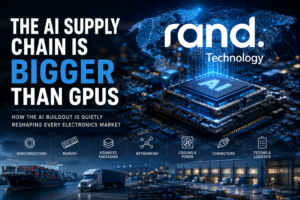
The artificial-intelligence boom has outgrown software headlines and now resides firmly in the hardware layer.
OpenAI’s seven-year, $38 billion infrastructure deal with AWS and Microsoft’s multi-billion-dollar expansions across Abu Dhabi and South Korea signal that compute power—not code—is the bottleneck.
Each new AI server requires thousands of validated components: DDR5 memory, GPUs, connectors, and power semiconductors.
As hyperscalers rush to deploy infrastructure, traditional supply chains, optimized for efficiency rather than agility, are straining.
Rand Technology’s advantage lies in its independence.
Unbound by OEM exclusivity or regional sourcing quotas, Rand can mobilize multi-region procurement, tapping the Asia-Pacific region for availability, the EMEA region for near-shoring stability, and the Americas for compliance confidence.
James Hill, Rand Technology President/COO:
“The AI race is a capacity race. But capacity without authenticity creates more risk. Our role is to make sure speed never outruns integrity.”
Rand’s certified processes (ISO 9001, AS6081, AS9120) and its 72-point “Rand Certified” inspection protocol ensure that the GPUs and ICs fueling AI systems arrive genuine, tested, and traceable—every time.
Automotive Regionalization: A Fragmented Future
If AI is stretching the top of the semiconductor market, automotive is pulling from the sides.
Multiple reports show the automotive supply chain fracturing into regional ecosystems:
- BYD will begin EV production in Hungary by the end of this year.
- Toyota, Honda, and Suzuki are investing $11 billion to expand production in India.
- Volkswagen is developing an in-China system-on-chip (SoC) through its CARIZON JV with Horizon Robotics.
This “multi-pole manufacturing” trend means OEMs now face an entirely new sourcing challenge:
Regulation, origin, and trade policy now drive formerly standardized global parts to diverge.
Andrea Klein, Rand Technology CEO:
“Automotive supply chains were built for linear production. The next decade will reward networks that think in loops—circular, regional, and resilient.”
Rand supports global automakers by managing shortage response, buffer inventory, and scheduled deliveries across North America, EMEA, and APAC.
As tariffs and export controls reshape sourcing decisions, Rand’s agility and local-to-global logistics network ensure customers maintain both continuity and compliance.
Quality and Authenticity in a Volatile Market
Recent months have revealed how quickly geopolitical tension can disrupt component authenticity flows. The Nexperia export dispute between China and the Netherlands temporarily halted automotive chip deliveries before partial resumption in late October 2025.
Such events often drive opportunistic counterfeit infiltration as constrained buyers turn to unvetted channels.
Rand Technology’s Rand Certified process directly addresses this risk.
Each incoming component undergoes:
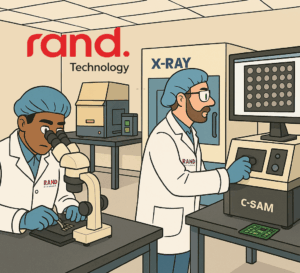
- Visual, X-ray, and decapsulation analysis
- Electrical functionality testing
- Packaging and lot-trace validation
- Documentation and serialization into Rand’s ERP compliance ledger
Competitors mention quality, but Rand backs it with quantifiable inspection rigor and transparent reporting.
Where others rely on automation, Rand blends human expertise and advanced testing infrastructure to ensure trust in every transaction.
Rare Earths, Raw Materials, and the Next Bottleneck
There is another layer of supply-chain fragility: the dependency on rare earths. China’s continued export restrictions and the slow roll-out of alternative mining projects in Brazil and Japan/US joint zones keep magnet-grade materials tight.
While not every distributor can influence mining policy, Rand mitigates downstream impact through proactive materials forecasting and substitution sourcing.
For example, Rand’s engineering support teams collaborate with OEMs to identify cross-compatible components before shortages cascade into production delays.
Independent Integrity: The Human Element
A striking trend in the component industry is the shift toward platformization. Digital marketplaces and procurement-automation models promise efficiency but often sacrifice relational trust.
Rand Technology represents the countercurrent: human partnership reinforced by technology, not replaced by it.
Its global account teams, strategic commodity analysts, and engineering experts function as embedded extensions of clients’ SCM and GCM operations.
“AI can match part numbers. Only people can build partnerships.”
Rand’s value chain reflects this human-centered philosophy across every stage, from BOM analysis and lifecycle extension to end-of-life asset disposition.
It’s why leading Fortune 500 manufacturers continue to integrate Rand into their core supply management frameworks.
Building the Future Supply Chain: Predictive, Ethical, and Circular
Resilience is not merely surviving volatility—it’s anticipating and absorbing it. The data paints a picture of a world where localization, AI acceleration, and sustainability are converging forces.
Independent distributors must therefore evolve from transactional brokers into predictive partners that guide decision-making.
Rand’s roadmap already reflects this evolution:
- Predictive Market Intelligence – combining supplier data with macroeconomic signals to forecast lead-time shifts and pricing pressure.
- Circular Economy Alignment – helping clients recover value from surplus and obsolete inventory through consignment and reuse.
- Ethical Sourcing Frameworks – embedding traceability, diversity, and environmental accountability into every transaction.
“True resilience means that when disruption hits, you don’t just endure; you advance. That’s the philosophy behind every solution we deliver.”
Why Resilience Is the New Competitive Edge
From hyperscale data centers to hybrid vehicles, the technology landscape is accelerating faster than traditional supply chains can keep up with.
Tariffs, export restrictions, and AI hardware booms are not short-term anomalies; they are the new normal in the operational environment.
Rand Technology stands at the intersection of agility and authenticity—independent, certified, and purpose-driven.
As competitors chase volume and velocity, Rand focuses on continuity, compliance, and trust. In the race to resilience, it’s not about being the biggest.
It’s about being the most dependable.